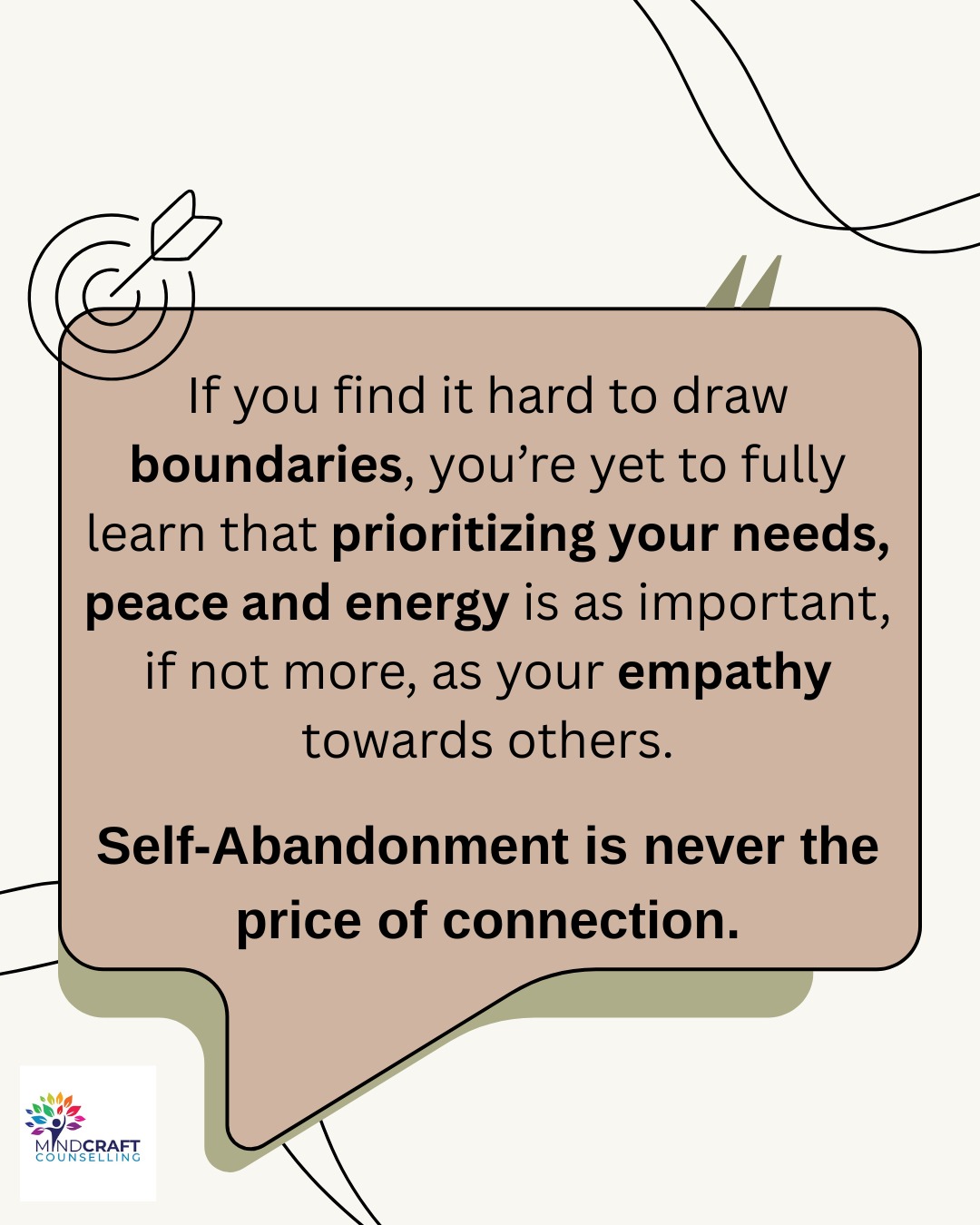
If drawing a boundary leaves you tangled in guilt, the problem usually isn't that you lack the words. It's a quiet belief running underneath: that your needs matter less than everyone else's, and that putting yourself first is somehow selfish. So you say yes when you mean no. You stay late, absorb the mood, smooth things over, and call it kindness. Over time, that pattern has a name — self-abandonment.
Empathy and self-respect aren't opposites
Plenty of people who struggle with boundaries are deeply caring. That's exactly why it's hard. You feel other people's discomfort sharply, and you'd rather carry it yourself than let them sit with it. But empathy that only flows outward eventually runs you dry. Your needs, your peace and your energy are not a lower priority than someone else's comfort. They're at least as important — and protecting them is what keeps you able to care for anyone at all.
A boundary isn't a wall built to keep people out. It's a line that tells others, and yourself, where you end and they begin. Far from pushing connection away, clear limits are what make honest closeness possible. When you keep agreeing to things you resent, the relationship is running on a version of you that isn't quite real.
Where the difficulty comes from
For many of us, the wiring was set early. If love felt conditional growing up — earned by being easy, helpful or low-maintenance — then asserting a need can feel genuinely dangerous, like risking the very bond you depend on. That's not weakness. It's an old survival strategy that made sense once and lingers now. Naming it gently is the start of changing it.
You might notice self-abandonment shows up as:
- Saying yes automatically, then dreading the thing you agreed to
- Apologising for having a preference at all
- Feeling responsible for managing other people's emotions
- Going quiet about what hurt you to keep the peace
- Exhaustion that you can't quite explain
Practising the small no
You don't have to overhaul your relationships to begin. Start with something low-stakes. Notice the moment your body tightens at a request — that flicker of I don't want to — and let it count. You can buy time: "Let me check and get back to you." You can decline without a lengthy justification: "I can't take that on right now." A boundary doesn't need to be defended to be valid.
Expect the guilt to arrive anyway. It will, especially at first. Guilt is not proof you've done something wrong; here it's usually just the old programming firing as you do something unfamiliar. Let it be there without obeying it. The people who genuinely value you will adjust. The discomfort some feel when you stop over-giving is theirs to hold, not yours to fix.
Choosing yourself doesn't make you cold. It makes the love you offer freer, because it comes from a person who is actually present rather than performing. You can stay kind and still keep something back for your own life. In fact, that's the only way kindness lasts.