
One of the most common reasons people put off therapy is a quiet internal audit: Is what I'm going through bad enough to justify this? They weigh their struggles against some imagined threshold, decide they fall short, and carry on. But measuring the intensity of your problems is the wrong place to start. Therapy isn't a reward you earn by suffering enough. It's a way of relating to your own life with more clarity and care.
Life doesn't move in straight lines
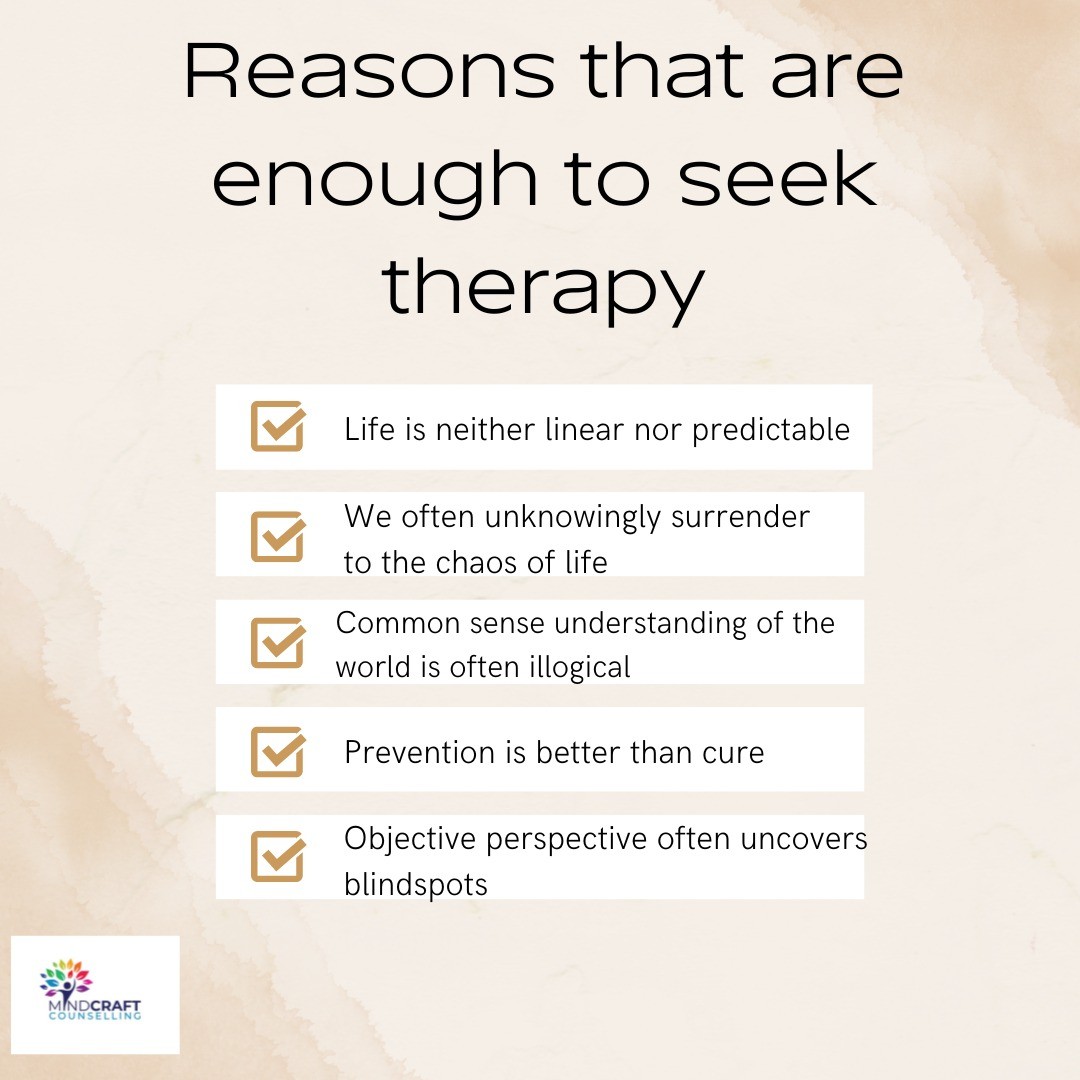
Life is neither linear nor predictable. We end up in situations we never planned for, and the decisions we make carry consequences we couldn't have seen coming. The decisions we avoid often leave their own residue — regret, second-guessing, a low hum of what if. Therapy doesn't promise to remove uncertainty. It helps you find direction inside it, and steady support for the stretches that feel hardest to walk alone.
Autopilot feels safer than it is
When life moves fast, it's tempting to stay passive and wait for time to sort things out. Staying in autopilot feels easier, because real action asks something of you — sitting with emotions, untangling thoughts that crowd the mind, making effort when avoidance is right there. The trouble is that passivity quietly erodes a sense of purpose. Drifting can feel like rest, but over time it costs you the chance at a life that actually feels like yours. Therapy helps you step out of autopilot and back into choosing.
We're more biased than we think
We like to believe our intuition and experience give us an accurate read on the world. Often what's running underneath are cognitive distortions and old mental shortcuts that don't switch off. The world rarely splits cleanly into black and white — it works in shades and probabilities. A good part of therapy is gently unlearning rigid stories and relearning a more flexible, honest picture of how things actually are.
Prevention beats waiting for it to pass
So often we postpone the hard work. We tell ourselves it's just a phase, that we'll learn as we go, that eventually we'll toughen up and stop feeling it. But why let difficulty accumulate? Why endure something now that could be addressed before it grows heavier? Working on things early isn't dramatic or self-indulgent — it's the same logic as catching a small problem before it becomes a large one. Therapy can speed up the process of coping and healing, and not only for the past and present. It builds capacity for whatever comes next.
An outside view sees what you can't
There's real value in confiding in someone trained to hold what you share with care and respect — someone outside your situation entirely. We all have blind spots, places we're in quiet denial about, patterns we're too close to notice. An objective perspective doesn't judge you for them; it helps you see them, sometimes for the first time.
If you've been waiting until things get bad enough, consider that the waiting itself might be the thing worth looking at. You don't need permission, and you don't need a breakdown. Wanting to understand yourself a little better is reason enough.